
The intention of this letter is to raise awareness regarding the background information and details of the hardware utilized in in-plane CLT diaphragm steel spline/strap shear connections.
As the industry increasingly explores alternative materials and methods, such as incorporating light gauge steel splines in CLT diaphragm shear connections, it becomes imperative to validate the accuracy of the design assumptions in accordance with codes and standards through testing, research, and verifications. This becomes even more critical in regions prone to seismic activity, where ductile failure mechanisms are required in connections, and the choice of materials and design approaches can significantly influence the building seismic performance.
The seismic resilience of timber buildings relies heavily on the ductile behavior of the connections (e.g. ability of fasteners to deform beyond the elastic region). To promote connection designs with fastener yielding modes and favourable overstrength and ductility, guidelines and standards mandate specific characteristic ductile failure mechanisms . In SDPWS-2021 (clauses 4.5.3 and 4.5.4), fastener ductility is controlled in two manners: an overstrength value of 4.5 applied to Z*, and a requirement for fastener yielding in modes IIIs or IV. We will explore specific concerns in the subsequent sections:
1) Overstrength factor
NDS-2024 and ICC-ES AC-233 (acceptance criteria for slender dowel-type fasteners) specify a minimum reference or safety factor of 5.0 to lateral connections for dowel-type fasteners. The overstrength value of 4.5, specified by SDPWS-2021, pushes the nominal shear capacity of a screw closer to – but not exceeding – the ultimate value. When utilizing steel straps, however, there has been evidence of discrepancy between calculated yield modes and observed testing results, where the steel strap deformation/failure is the limiting factor. If a light gauge steel spline is introduced and governs the shear capacity of the diaphragm connection one is no longer comparing like-to-like and an overstrength value of 4.5 is no longer appropriate. The overstrength for steel connectors overstrength value or factor of safety is 3.0 or lower per ICC-ES AC-13 . This gap in design procedure and interpretation would pose a risk in achieving the desired ductility and more specifically the overstrength value (4.5 x Z*), attributable only for the intended yielding mechanisms of fasteners in CLT-based lateral force-resisting systems.
Additionally, NDS-2024 clause 11.2.3 and Appendix B.3 stipulate that when the capacity of the connection is governed by metal strength rather than wood strength, connection capacity shall not be increased by the short-term duration factor of CD. This is particularly the case, when CLT steel spline connection design is governed by the steel strap yielding (buckling, tension yielding etc.,) mechanism.
2) Fastener yielding modes
Furthermore, to promote a ductile connection associated with wood bearing and fastener bending deformations, SDPWS 2021 (which is reflected in IBC-2021) clause 4.5.4 requires calculated yield Mode IIIs or Mode IV per NDS-2024 for in-plane diaphragm shear connections (Figure. 1). If the failure is governed by the light gauge steel strap, then it may not be expected to observe yielding behaviours of any sort in the fasteners.
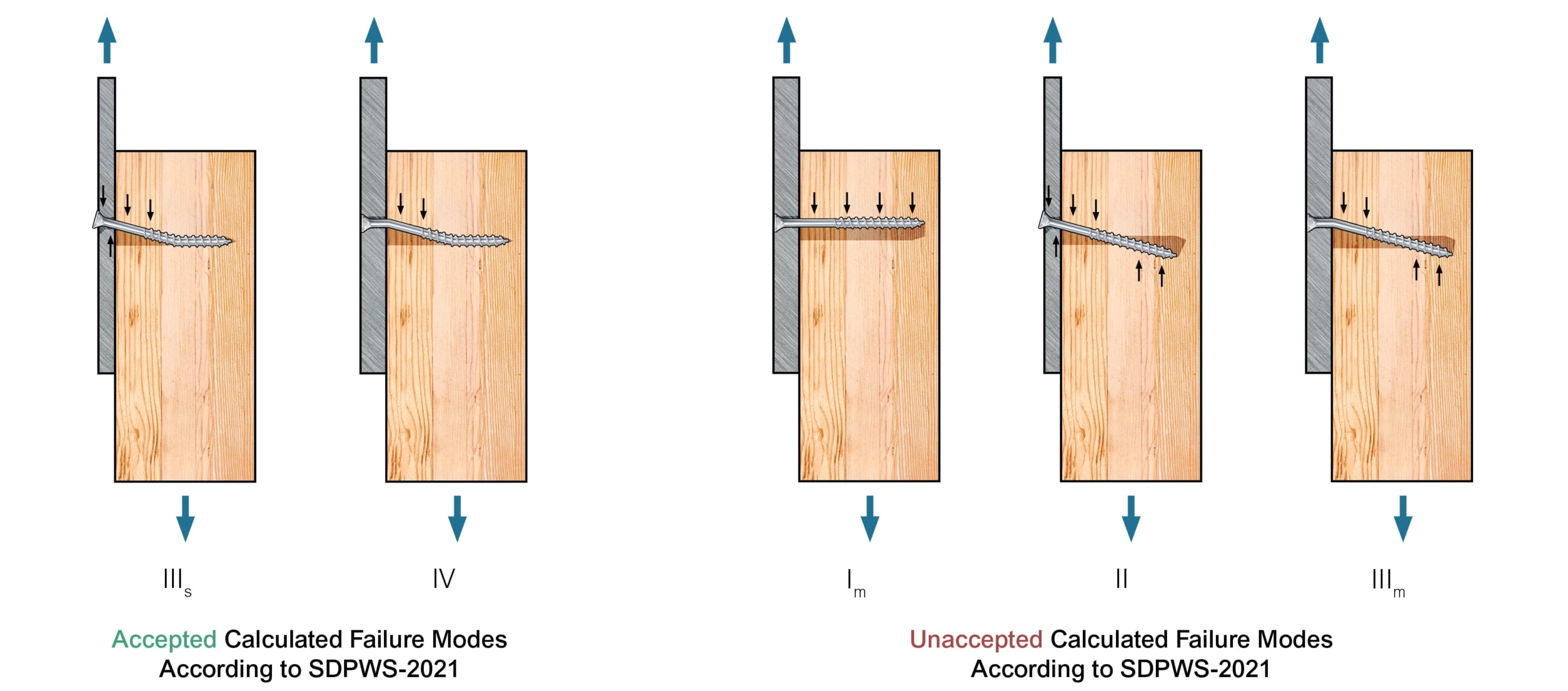
Figure.1 SDPWS-2021 Failure Mode Requirements
According to ICC-ES AC-233 clause 3.4.1.3, if the tested reference lateral design values (considering a reference reduction factor of 5) are less than 85 percent of the calculated design values, the lateral capacity needs to be determined by testing and use of NDS-2024 provisions are not justified. Similarly, if the calculated yield mode is IIIs , IIIm or mode IV, but the observed failure mode is Im, Is, or II, use of NDS-2024 has not been qualified and lateral capacity shall be determined through testing (clause 3.4.2) and considering the Rs factor to account for steel side plate properties (e.g. Line et al. 2022).
3) Fastener’s ductility
In the context of steel-to-wood connections of CLT diaphragm such as spline and strap, it is essential to consider the behavior of various fastening systems under different loading conditions. Some reports indicate that subfloor screws, often used in these applications, exhibit higher strength and hardness. This increased hardness translates into less ductile behavior, a significant concern since the ability of the fastener to deform and develop the yielding mechanism is a key factor in ensuring the compliance of diaphragm design with the standard provisions . See figure 2 for a side-by-side comparison of MTC Solutions’ fastener ductility versus a screw exhibiting an excessive hardness.
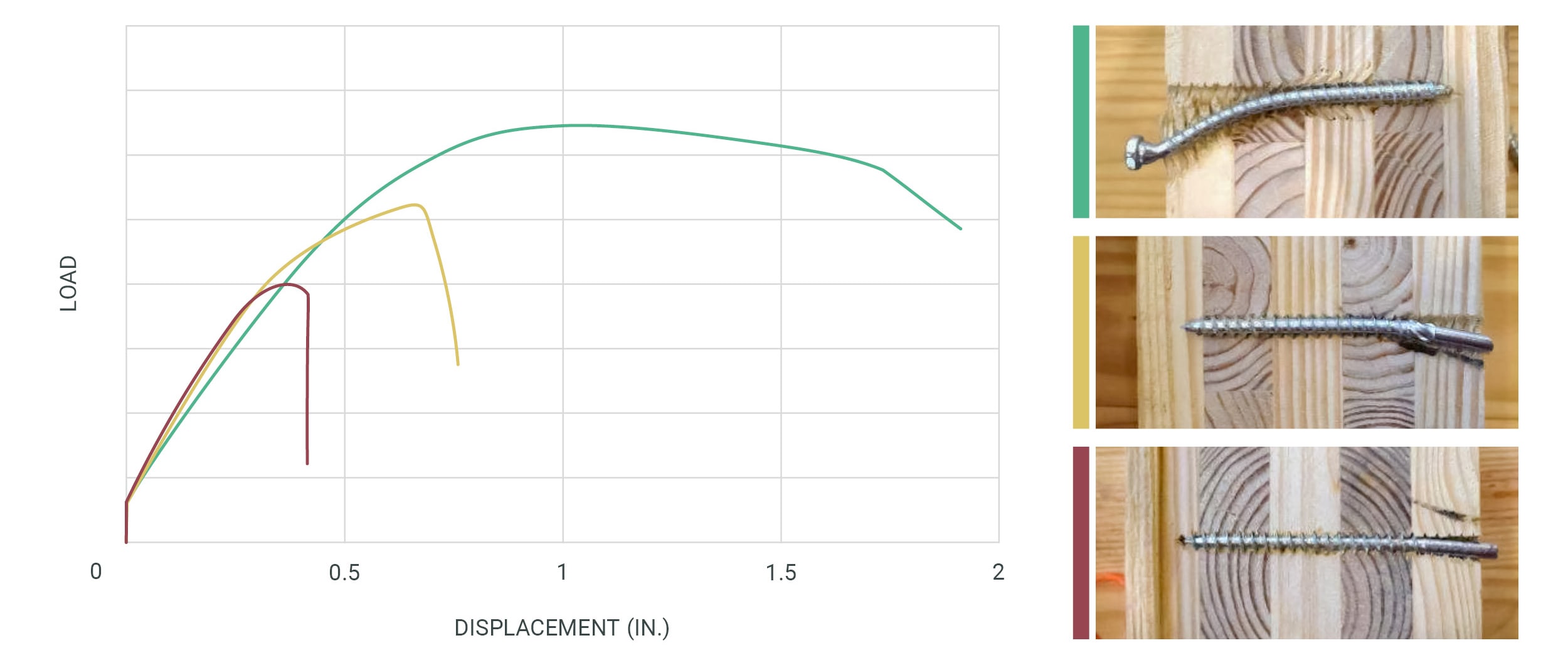
Figure.2 Ductile Self-Tapping Screws vs Brittle Screw Behavior for Screws with Different Hardness and Bending Yield Strengths.
4) Reverse cyclic performance
Our concerns also extend to the use of nails in steel/wood splines, particularly in scenarios involving reverse cyclic loading. Nails are typically used when a more ductile connection is necessary and low pull-out forces are expected. Test results indicate that common nails, when compared to threaded fasteners (e.g. self-tapping wood screws), do not provide the same level of engagement and stability within the wood, potentially compromising design assumptions. This would be especially apparent after multiple cycles of lateral loads, where nails would tend to withdraw in increments of cycles.
To address these concerns, we recommend the use of high-quality self-tapping wood screws that are heat treated to allow certain ductility before breaking. MTC Solutions’ self-tapping screws combined with plywood splines are made to allow for the development of yielding mechanisms in line with NDS-2024 and SDPWS guidelines (Figure. 2). This approach not only aligns with industry standards but also offers enhanced reliability, ease of design, and installation. Extensive testing results (e.g. Line et al. 2022, Sullivan 2017, Taylor 2020, Jalilifar 2021) have validated the performance of this system, ensuring the long lifespan and structural resilience of mass timber buildings.
In conclusion, regarding the design of steel-to-wood connections used in CLT diaphragms (such as spline and strap), it is important to note that not all screw connection designs (and not all wood screws with their specific manufacturer’s details) are aligned with design provisions nor demonstrate perfect material compatibility. In simple words, common wood screws such as framing screws, lag bolts and other screws used in construction may not be designed to be able to deform properly under load. NDS and SDPWS both rely on fastener-yielding mechanisms to achieve the desired ductility, overstrength and energy dissipation. Hence, specific considerations need to be considered when using different fastening solutions. We are committed to not only adhering to industry best practices but also driving innovation through research and development. Our goal is to provide solutions that are not only technically superior but also practical and sustainable for the long term. By sharing our findings and engaging in open dialogues with industry leaders, we aim to collectively enhance the safety, reliability, and efficiency of mass timber construction.
I would be delighted to discuss these findings in greater detail and explore how our expertise can contribute to your ongoing and future projects. Our team is always eager to participate in collaborative discussions that propel the industry forward and contribute to its sustainable growth.
Thank you for considering our insights. I look forward to the opportunity of deeper collaboration and advancing our shared goal of progressing the mass timber industry.
Sincerely,
Register for a Technical Learning Session
Sign up for MTC Newsletter and keep up to date with all our progress.